The Silver Valley’s history is deeply rooted in mining. What started with a few mining claims quickly exploded into an industry that was created and remains the backbone of our community.
From 1886 to 1997, it is estimated that Silver Valley mines processed and concentrated approximately 130 million metric tons of metal-bearing materials, generating 109 million metric tons of mill tailings as waste byproducts. The topography of the region provided limited flat land for stockpiling and saving tailings and this became problematic for most of the mills throughout the region.
While the most convenient and common method of tailings disposal was to directly discharge them into local streams and creeks, some of these materials were used for more productive means.
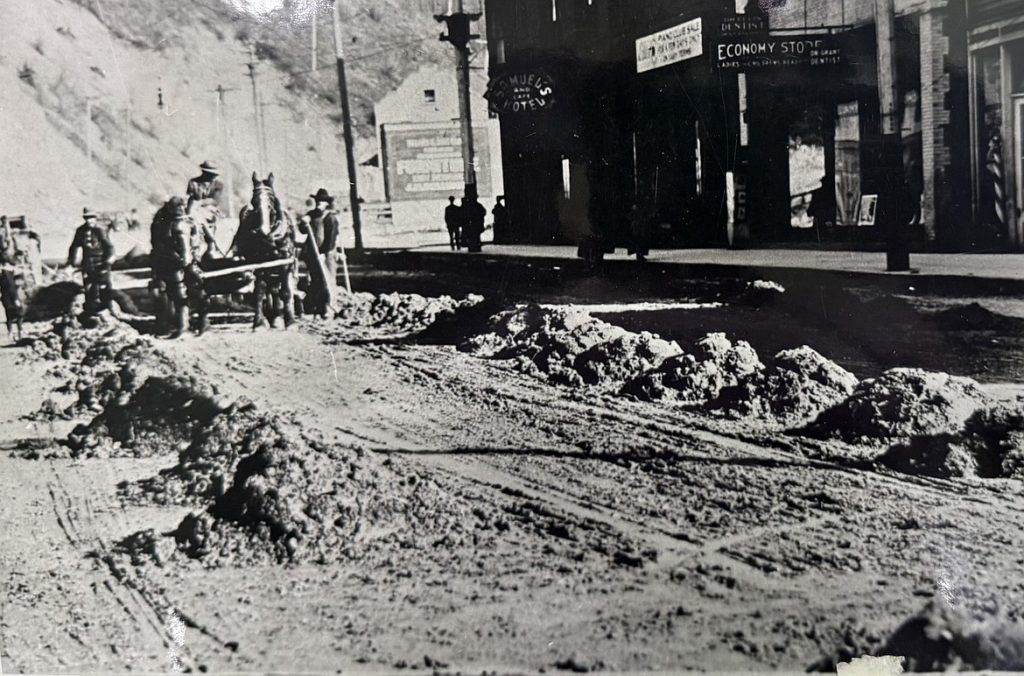
One of the most common uses was the construction of local freeways, roads, railroad ballast, and driveways. For example, during the early 1900s, the City of Wallace procured and maintained a stockpile of tailings from the Standard-Mammoth Millsite. For years, the city used horse-drawn buggies and manual labor to dump and spread tailings throughout town for new roadways and for the maintenance of pre-existing roads.
In the 1960s approximately 2.6 million tons of tailings were removed from the Bunker Hill Mine’s impoundment pond and were used to build the roadbed for Interstate 90 through the Smelterville and Kellogg areas. Approximately one million tons of tailings were also used to create the Interstate 90 roadbed near Cataldo using dredge material placed between two parallel dikes. In addition to large-scale road projects, it was also common for homeowners and contractors to use these materials on smaller projects, such as to build and improve driveways, as fill materials, or for use as a base for concrete slabs, and sidewalks.
While these materials were utilized for their convenience and practicality, they unintentionally became a major exposure source of lead, arsenic, and other metal contaminants for both humans and the environment.
The abundance of these cheap, or often free, materials naturally encouraged their widespread use. This caused contamination to be spread to areas that would not have been impacted by mine waste.
When the Bunker Hill Superfund site was established in 1983 and cleanup efforts began, road shoulders, rights of ways, ditch lines, and driveways were a major consideration for the cleanup remedy.
Since cleanup began, thousands of driveways and hundreds of miles of road shoulders have been remediated to remove surface contaminants and replaced them with clean materials, creating a protective barrier between us and the contaminated materials underneath. The next time you are out for a drive, consider what you might find below the asphalt under your tires.
The Dirt is a series of informative articles focused on all aspects of cleanup efforts associated with the Bunker Hill Superfund Site. Our goal is to promote community awareness of contamination issues, to provide tools for protecting public health, and to keep the community informed of current and future cleanup projects. The Dirt is a group of committed and local experts from multiple agencies, including the Basin Environmental Improvement Project Commission, Panhandle Health District, Shoshone County, Silver Valley Economic Development Corporation, and the Idaho Department of Environmental Quality.
 Official Government Website