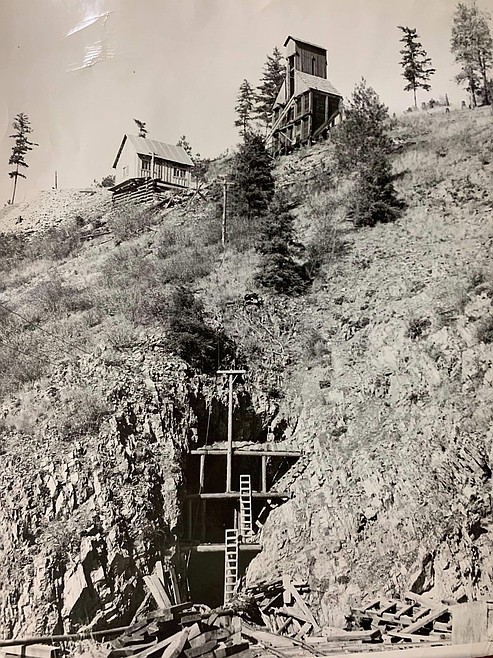
While not as notable as Bunker Hill, Sunshine, or the Hecla Star, the mines of Pine Creek cannot go without proper recognition for their contributions to the Silver Valley. The Pine Creek Mining District, formerly known as the Yreka Mining District, is a smaller region within the larger Coeur d’Alene Mining District. Attributed to William Reineger in 1886, the discovery of Pine Creek’s lead-silver ore occurred two short years after its discovery in the larger district. Shortly after Reineger’s initial discovery, numerous other ore-rich areas were identified, and Pine Creek became home to over a dozen mines and several mills.
Mineral bodies in the Pine Creek region were composed of a complex mixture of zinc, lead, silver, and antimony ores that early milling and processing methods struggled with. In the early years of milling, there was little to no attempt made to recover zinc due to inadequate processing technology. As such, little mining occurred until the onset of World War I, when high metal prices and demand stimulated development and resulted in considerable production. The Pine Creek district faced multiple issues when attempting to install a rail line to transport ore. In 1917, after several miles of track were completed, a washout severely damaged portions, and the work was discontinued. This inability to complete a branch line in the district slowed production after the war.
Direct discharge disposal practices, legally used throughout the larger district, were also implemented in Pine Creek. Massive quantities of tailings were discarded throughout the drainage during this time. With only inefficient recovery methods available, this disposal practice introduced metal-laden waste products into Pine Creek and its tributaries. These sediments contained lead and other metals that were hazardous to humans, the environment, and aquatic species such as cutthroat and bull trout. These activities also increased the sediment loading within the creek bed and widened the stream channel in many stretches.
With the invention of the selective flotation concentration method in the 1920s, metal recovery rates greatly improved. This allowed mills to easily separate individual metals, creating a new market for zinc. The Sullivan Mining Company, owned by Hecla and Bunker Hill, constructed the very first electrolytic zinc plant in the United States to capitalize on this new process. The new zinc plant was constructed in Government Gulch just south of Bunker Hill’s lead smelter. Bunker Hill also remodeled its Sweeny Mill to handle custom ores from the Pine Creek mines. A 3.5-mile tramway was constructed to transport Pine Creek ores. This tramway ran from the Sidney Mine, located at the head of Red Cloud Creek, northeast over the mountain to the Sweeny Mill at the bottom of Government Gulch.
Higher efficiency recovery rates and the construction of the zinc plant contributed to a period of sustained mining activity between 1924 and 1930. Unfortunately, the mines were not immune to the ill effects of the Great Depression, which led to reduced operations or the complete shuttering of many mines. Recovery took time, but the passage of the federal Silver Purchase Act in 1934 encouraged mines that produced silver to reopen. At the end of the decade, rumors of war boosted metal prices even more, and local mills began processing ore that had been stockpiled during the depression.
With the onset of World War II, the demand for lead, zinc, and antimony grew, but many mine and mill workers joined the armed services, thereby creating a labor shortage across the industry. As a result, production from the Pine Creek mines never again reached the levels they had during World War I. In the 1950s, new federal programs instituted by the Department of the Interior encouraged exploration, development, and mining, benefiting many area mines, but these programs were short lived. By the end of the 1960s, a combination of factors, including declining metal prices, higher operating costs, and dwindling reserves, led to the permanent closure of most of the Pine Creek mines and mills. Smaller operations and exploration work continued into the 1980s, but by this period in time the mining rush of Pine Creek was all but over.
The Dirt is a series of informative articles focused on all aspects of cleanup efforts associated with the Bunker Hill Superfund Site. Our goal is to promote community awareness of contamination issues, to provide tools for protecting public health, and to keep the community informed of current and future cleanup projects. The Dirt is a group of committed and local experts from multiple agencies, including the Basin Environmental Improvement Project Commission, Panhandle Health District, Shoshone County, Silver Valley Economic Development Corporation, and the Idaho Department of Environmental Quality.

 Official Government Website